Key Takeaways
- Early structural assessment by a Board Certified Master Arborist detects hidden liabilities like hollow trunks, co-dominant stems, and root rot before heavy winds strike.
- Proactive directional and structural pruning eliminates high-risk deadwood and reduces wind resistance within the canopy.
- Root zone protection preserves the primary anchors of your trees by avoiding severe soil compaction and critical root cutting.
- Cabling and bracing systems offer internal, high-tensile physical support to structurally weak or historically significant mature trees.
- Enlisting local, fully insured professional arborist services safeguards your financial interests and physical property during volatile weather.
Every year, property owners across St. Cloud, Minnesota and the surrounding Central Minnesota communities watch the summer horizon with a mix of awe and anxiety. When severe weather patterns roll across Stearns County, they bring intense straight-line winds, heavy downpours, sudden tornadoes, and violent lightning strikes. While our local landscapes owe much of their natural beauty to mature, sweeping tree canopies, these same towering structures present considerable hazards when exposed to extreme atmospheric forces. A single compromised limb or a structurally unstable root system can quickly transform an irreplaceable asset into a devastating liability, crashing through rooflines, severing overhead power lines, or destroying surrounding landscapes.
Failing to prepare for this annual meteorological onslaught leaves your property completely vulnerable to the elements. Tree care during an active severe storm system is practically impossible; the real work must occur long before the first severe weather alert sounds across your phone. By understanding the primary mechanics of storm-induced tree failures and executing a targeted, proactive structural maintenance plan, you can dramatically improve your landscape’s resilience, minimize your financial exposure, and protect the people who inhabit your property.
The Mechanics of Tree Failure During Severe Storms
To adequately protect your trees, you must first recognize how and why they fail under intense environmental stress. Tree failure during a storm is rarely a spontaneous, unpredictable accident; it is almost always the sudden culmination of pre-existing, underlying structural weaknesses exposed to extreme kinetic forces.
a.) The Sail Effect and Wind Load
When strong wind forces collide with a full summer canopy, the entire tree acts like a giant sail. A healthy tree manages this intense force through natural elasticity, flexing its branches, distributing the kinetic energy down the trunk, and transferring the load into a deep, sprawling root network.
b.) Co-dominant stems
If a tree possesses structural anomalies, this energy distribution loop fails. For example, co-dominant stems of trunks of equal size growing tightly together from a single point lack the strong, interlocking wood fibers found in normal branch attachments. Instead, they form included bark zones that act like a wedge, slowly pushing the stems apart over time. When high winds hit, the sail effect forces these stems in opposite directions, splitting the tree down its core. Similarly, internal decay caused by wood-boring pests or fungal pathogens leaves the interior trunk hollow, stripping away the wood needed to withstand heavy bending forces.
Spotting Hidden Hazards: The Pre-Storm Inspection
Protecting your landscape begins with a systematic, ground-level structural inspection. You should walk your property early in the spring, looking closely at each mature tree from three distinct perspectives: the wide canopy, the main trunk, and the immediate root flare zone.
Assessing the Upper Canopy
In the upper canopy, keep a sharp eye out for dead, dying, or totally bare branches. These limbs are dry, brittle, and completely devoid of structural flexibility; they are usually the very first elements to snap and become dangerous aerial projectiles in high-wind conditions.
Trunk Anomalies and Cavities
Moving down to the main trunk, look closely for deep structural cracks, splitting bark, or large, open cavities. These are obvious signs of advanced wood decay and localized structural failure. Pay special attention to areas where multiple major branches attach close together, looking for any signs of oozing sap or visible structural movement.
Root Flare and Soil Diagnostics
Examine the root flare in the critical area where the base of the trunk widens into the surrounding soil. The sudden emergence of fungal fruiting bodies, such as mushrooms or shelf bracket fungi at the immediate base, points directly to severe internal root rot. Furthermore, look for signs of recent soil lifting or cracked earth on the leeward side of the tree, which indicates the root plate is failing and the tree is actively tilting.
Strategic Pruning for Ultimate Wind Resistance
Proactive structural pruning is arguably the most effective preventative action a property owner can take to mitigate storm damage. The primary objective of storm-focused pruning is to reduce the overall sail effect of the canopy while entirely removing compromised limbs. This process requires a highly strategic approach; aggressive, unscientific hacking or topping a tree actually ruins its structural geometry, creating highly vulnerable, weak epicormic sprouts that will snap easily in subsequent storms.
A professional tree service firm in Minnesota will focus on crown thinning and removing weak branch attachments. By thinning dense interior branches, arborists help strong winds move safely through the canopy instead of pushing directly against the tree. This drastically reduces the total rotational torque applied to the trunk and root plate. Additionally, directional pruning ensures that branches maintain safe, clear distances from your home’s roofline, secondary detached structures, and nearby overhead service lines, preventing damaging contact if a limb sways heavily or partially breaks during a storm.
Preserving Root System Integrity and Stability
A tree is only as stable as the subterranean root matrix that anchors it to the earth. Unfortunately, the root zone is often completely overlooked until a major windstorm completely uproots the entire tree. In suburban St. Cloud environments, roots must constantly contend with serious environmental stressors, including deep soil compaction, poor water drainage, and sudden structural disruptions from ongoing construction, sidewalk repairs, or utility trenching.
To preserve your trees’ critical anchoring strength, establish a strict protection zone around the critical root radius generally extending out to the furthest edge of the leaf canopy. Never park heavy machinery, store heavy building materials, or allow consistent vehicular traffic over this sensitive area, as compacted soil starves roots of necessary oxygen and leads to slow, widespread root mortality. If you must undertake construction or install hardscaping nearby, ensure you avoid severing major lateral roots. Severing even a single root measuring over three inches in diameter can instantly strip away a massive percentage of a tree’s total stabilization capacity, making it exceptionally prone to windthrow.
Advanced Structural Support: Cabling and Bracing
In many situations, an incredibly valuable, historic, or aesthetically central tree may possess a known structural flaw such as a tight co-dominant stem or a slightly overextended heavy limb but removal is not the desired outcome. For these specific high-value trees, supplemental structural support systems like cabling and bracing offer an exceptional alternative. These systems do not rigidly lock the tree in place; rather, they act as an insurance policy, limiting extreme structural movement during intense storm events.
Tree cabling involves installing high-strength, flexible steel or synthetic cables high up in the canopy between major competing stems. These cables allow the tree to move naturally in gentle breezes, which is essential for developing natural structural wood strength, but they tautly catch and support the limbs when extreme wind forces threaten to tear the co-dominant union apart. Bracing uses threaded steel rods inserted completely through the lower trunk union to mechanically pin splitting wood together. Because installing these heavy industrial systems requires precision drilling and deep knowledge of tree biology, they must be designed and installed exclusively by qualified professionals to prevent causing further internal decay or structural damage.
Keep Your Property Safe with Total Control Tree Service
When severe weather threatens the St. Cloud region, you cannot afford to leave your property’s safety to chance. Total Control Tree Service provides elite, comprehensive storm preparation and hazardous tree mitigation tailored specifically to our local Minnesota climate.
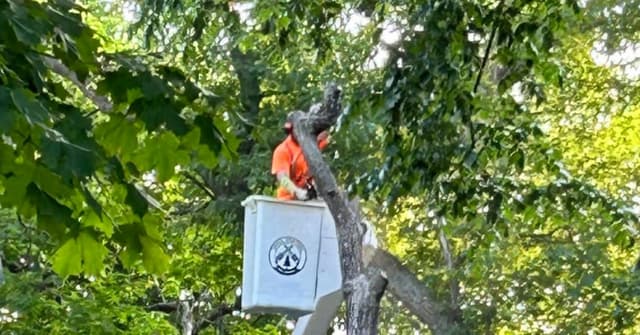
Founded by Skip Virchow, a Board Certified Master Arborist with over a decade of elite industry experience, our family-owned company brings unparalleled expertise directly to your doorstep. Backed by ISA Certified Arborist Spencer Silvers and our skilled rigging expert Ben Blonigen, we specialize in tree removal, tree pruning, tree trimming, 24/7 emergency tree service, stump removal & grinding, shrub removal & trimming, land clearing, plant health care, tree injections, tree cabling & bracing, Emerald Ash Borer treatment, and tree risk assessment. We use advanced rigging systems that bring hazardous limbs safely to the ground.
We utilize top-tier Tree Risk Assessment Qualification (TRAQ) standards to detect hidden internal decay and root instabilities before high winds expose them. Contact Total Control Tree Service today to schedule your comprehensive pre-storm property evaluation and secure your peace of mind.
Frequently Asked Questions About Tree Protection Before Storm in Minnesota
How can I tell if a mature tree on my property is at risk of falling during a storm in Minnesota?
Look for critical warning signs such as a sudden lean, deep open cracks along the main trunk, tight V-shaped co-dominant stems, dead branches in the upper canopy, or fungal growths at the base. If you notice any combination of these symptoms, a professional Tree Risk Assessment is strongly recommended.
Is it safe to trim large, heavy tree branches on my own before storm season?
No. Trimming large, heavy branches requires specialized climbing gear, advanced rigging systems, commercial-grade chainsaws, and extensive safety training. Attempting this yourself carries extreme risks of severe personal injury, falls, and property damage, and improper cuts can permanently ruin the tree’s health.
What exactly is tree topping, and why is it considered bad for storm readiness?
Tree topping is the indiscriminate cutting of main upper trunks and branches. It triggers a shock response where the tree rapidly grows weak, weakly attached epicormic shoots. These shoots lack proper structural integrity and break very easily in future storms, worsening the hazard.
Can a tree with advanced internal trunk decay still be saved from storm failure?
It depends entirely on the extent of the decay. If the outer shell of sound wood is sufficiently thick, structural cabling or strategic crown reduction pruning may mitigate the risk. However, if the decay is too widespread, complete removal is usually the only safe option.
How close can a tree safely be to my home in Minnesota before it becomes a storm hazard?
There is no single safe distance, as it depends on the tree’s species, height, and structural health. The main concern is whether the canopy overhangs the roof or if the height allows the tree to strike the structure if it falls. Consistent pruning keeps overhanging limbs at a safe distance.
How do supplemental cabling and bracing systems protect trees from high winds?
Cabling and bracing reinforce weak architectural points, such as co-dominant stems. Cables installed high in the canopy limit excessive swaying during high winds, while steel bracing rods pin splitting trunk unions together, preventing the tree from tearing apart.
Does heavy rain during St. Cloud storms increase the overall likelihood of tree uprooting?
Yes. Heavy downpours fully saturate the soil, drastically reducing the friction and holding power of the root system. When saturated soils are combined with strong, sustained straight-line winds, otherwise healthy trees can suffer complete windthrow.
When is the ideal time of year to schedule preventative storm pruning for my trees in Minnesota?
The best time is early spring or late winter when trees are dormant. This allows clear visibility of the tree’s architecture and gives pruning wounds time to begin healing before summer storm systems and pest cycles peak.
Summary Checklist: When to Call for Removal
| Condition | Risk Level | Recommended Action |
| Sudden Leaning | Critical | Request an emergency tree assessment immediately. |
| Large Trunk Cracks | High | Schedule a professional inspection as soon as possible. |
| Mushrooms or Fungus at the Base | Moderate to High | Have the tree inspected for internal decay and structural weakness. |
| Dead or Bare Branches | Varies | Consult an arborist to determine whether pruning or removal is appropriate. |
| Overhanging Power Lines | High | Contact a qualified tree service and your utility provider if branches are touching or threatening power lines. |
Final Advice
If you notice any of these warning signs, do not wait for a storm to force the issue. An assessment from an experienced tree service firm in Minnesota can assist you in determining if the tree can be saved through specialized care or if it must be removed to protect your property.
Managing mature trees is an ongoing responsibility that demands professional-grade diagnostics. Minor structural anomalies that look harmless from the ground can quickly become points of total structural failure under the load of high-velocity winds. Proactive care is consistently more cost-effective than emergency storm responses and property restoration. Protecting your home involves creating a resilient buffer zone around your immediate living structures. To learn more about how Total Control Tree Service can assist you, book your free consultation today !!